

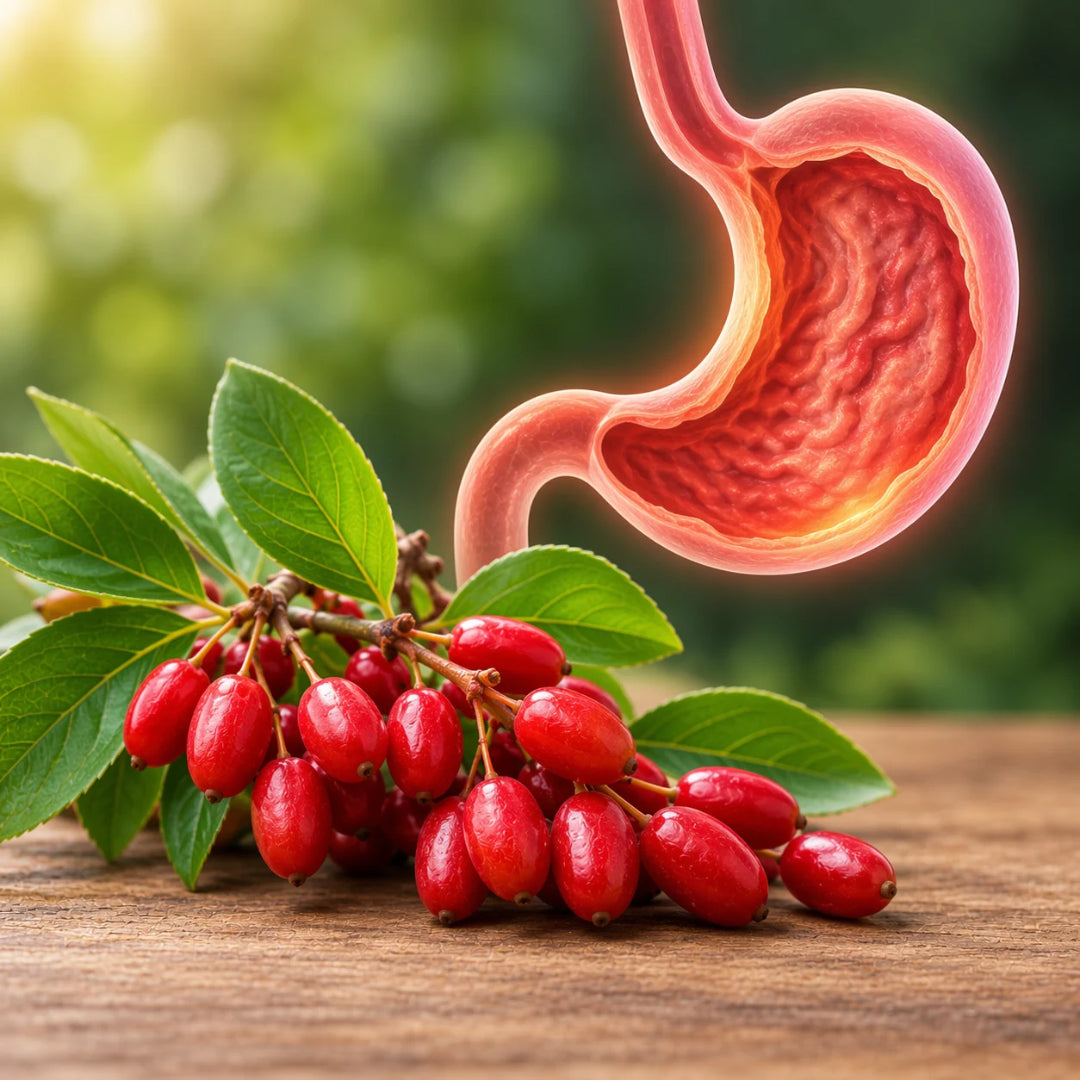
Can Berberine Help Fight H. pylori and Iron Deficiency?
Iron deficiency is often associated with inadequate dietary iron, heavy menstrual bleeding or poor iron absorption. But there is another potential contributor that receives less attention: a bacterial infection in the stomach.
Helicobacter pylori, commonly known as H. pylori, is a bacterium that can colonize the stomach lining. While many people with this infection experience few or no symptoms, it can contribute to chronic gastritis, peptic ulcers and, in some cases, iron deficiency anemia.
Researchers are also investigating Berberine, a plant-derived compound, for its potential antibacterial activity against H. pylori.
But how are these three connected? And can Berberine actually help?
What Is H. pylori, and How Can It Affect Iron Levels?
H. pylori is a bacterium that can survive in the stomach and disrupt the normal functioning of the stomach lining. It is one of the most common chronic bacterial infections worldwide.
Its connection with iron deficiency is particularly interesting because the stomach plays an important role in making dietary iron available for absorption.
Research has associated H. pylori infection with unexplained or persistent iron deficiency anemia, although not everyone with the infection develops low iron levels.
There are several possible explanations for this relationship.
1. It Can Interfere With Iron Absorption
The stomach helps prepare dietary iron for absorption in the small intestine. Stomach inflammation and changes in gastric acid secretion associated with H. pylori infection may interfere with this process.
This can make it more difficult for the body to obtain sufficient iron from food, particularly in people who already have low iron stores.
However, H. pylori does not simply switch off stomach acid. The effect on acid production varies depending on the location and severity of the inflammation.
2. The Bacteria Also Needs Iron to Survive
Iron is essential for many bacteria, including H. pylori. The organism has mechanisms that allow it to acquire and use iron within the stomach environment.
This creates a competition for an essential nutrient between the host and the bacterium.
However, the idea that H. pylori directly steals enough iron to cause anemia in every infected person oversimplifies the evidence. The relationship involves several interacting mechanisms.
3. Chronic Inflammation and Ulcers Can Contribute to Iron Loss
Persistent H. pylori infection can cause gastritis, which is inflammation of the stomach lining. In some cases, it can also lead to peptic ulcers.
When ulcers bleed, even slowly, they can contribute to ongoing iron loss. Chronic inflammation may also affect the body's ability to use and regulate iron normally.
For some individuals, these processes may contribute to iron deficiency that persists despite taking iron supplements.
Why Treating the Infection Matters
Iron supplements can help replenish iron stores, but they may not address an underlying cause of iron deficiency.
Clinical research has found that eradicating H. pylori can improve iron-related outcomes in some people with otherwise unexplained or treatment-resistant iron deficiency anemia.
The evidence is not identical across every population, and iron supplementation may still be necessary to restore iron levels.
This is why persistent iron deficiency may warrant further investigation rather than simply increasing the amount of iron consumed.
A healthcare professional may recommend testing for H. pylori, alongside blood tests such as a complete blood count and serum ferritin, depending on the individual's symptoms and medical history.
Where Does Berberine Come Into the Picture?
Berberine is a naturally occurring plant alkaloid that has been studied for its potential antimicrobial and anti-inflammatory properties. Research into its interaction with H. pylori has opened up interesting questions about how this compound may influence bacterial activity and gut health.
But not all Berberine formulations are the same. How an ingredient is formulated can influence how much of it becomes available for the body to use.
1. Potential Antibacterial Activity
Laboratory research suggests that Berberine may inhibit the growth of H. pylori under certain experimental conditions.
This has led researchers to investigate whether the compound could contribute to strategies for managing the infection.
However, laboratory findings alone cannot establish whether an oral Berberine supplement reaches the stomach lining at concentrations sufficient to eradicate the bacterium in humans.
2. Potential Effects on Inflammation
Because H. pylori can trigger inflammation in the stomach lining, researchers have also explored Berberine's effects on inflammatory pathways.
Some preclinical research suggests that Berberine may influence pathways involved in inflammatory responses.
Whether these effects translate into meaningful improvements in H. pylori-associated gastritis in humans remains uncertain.
3. Could Berberine Improve Standard Treatment Outcomes?
Another area of research is whether Berberine could be used as an adjunct to conventional H. pylori eradication therapy.
Some clinical studies have investigated Berberine-containing treatment regimens, including combinations with established medications.
However, the available evidence is not sufficient to conclude that Berberine consistently makes standard treatments more effective. Results depend on the treatment combination, study design, population and local antibiotic resistance patterns.
Berberine should not be considered a proven replacement for prescribed eradication therapy.
What About Berberine's Absorption?
Berberine is known for having relatively low oral bioavailability, meaning that only a limited proportion of an oral dose reaches systemic circulation in its unchanged form.
Researchers have explored different formulations and delivery approaches to address this limitation.
However, better absorption does not automatically mean better results against H. pylori. The relevant concentrations in the stomach and stomach lining, the formulation used and the overall treatment regimen all matter.
Claims about improved bioavailability should therefore be distinguished from evidence of successful bacterial eradication in human clinical trials.
Can Berberine Treat Iron Deficiency Anemia?
At present, Berberine should not be regarded as an established treatment for iron deficiency anemia.
Its potential antibacterial effects are an area of ongoing research, but there is insufficient evidence to recommend Berberine alone for eradicating H. pylori or correcting anemia.
If H. pylori is contributing to iron deficiency, the priorities are to identify the infection, treat it with an appropriate prescribed regimen and replenish iron stores when needed.
It is also important to investigate other possible causes of iron deficiency, including heavy menstrual bleeding, dietary insufficiency and gastrointestinal blood loss.
Berberine can cause gastrointestinal side effects and may interact with medications. Anyone considering it alongside prescribed treatment should consult a healthcare professional first.
The Takeaway
The relationship between H. pylori and iron deficiency highlights how a stomach infection can affect more than digestive comfort.
By contributing to stomach inflammation, altering the gastric environment and sometimes causing bleeding, H. pylori may play a role in persistent iron deficiency anemia.
Berberine is being studied for its potential antibacterial and anti-inflammatory properties, including its possible role in H. pylori treatment. However, promising laboratory findings and early clinical research should not be confused with established clinical recommendations.
The most evidence-based approach is to investigate the underlying cause of iron deficiency, confirm and appropriately treat H. pylori when present, and monitor iron levels as part of recovery.
FAQs
Can H. pylori cause iron deficiency anemia?
Yes. Research has linked H. pylori infection with iron deficiency anemia in some individuals. Possible mechanisms include impaired iron absorption, chronic inflammation and blood loss from ulcers.
Does Berberine kill H. pylori?
Laboratory studies suggest that Berberine may inhibit H. pylori under certain conditions. However, evidence is insufficient to establish Berberine alone as a reliable treatment for eradicating the infection.
Can Berberine help iron absorption?
There is currently insufficient clinical evidence to conclude that Berberine directly improves iron absorption or corrects iron deficiency.
Can I take Berberine with iron supplements?
The combination should be discussed with a healthcare professional, particularly if you take other medications or are receiving treatment for H. pylori. Berberine can cause gastrointestinal side effects and has the potential to interact with medicines.
Should I stop taking iron supplements if I have H. pylori?
No. Do not stop prescribed iron supplementation without medical advice. Treating the infection and replenishing iron stores may both be necessary.
How is H. pylori treated?
Treatment generally involves a prescribed combination of acid-suppressing medication and antibiotics, sometimes with bismuth. The specific regimen depends on clinical guidelines, prior antibiotic exposure and resistance considerations. Follow-up testing is generally recommended to confirm eradication.
What is Metaberine™?
Metaberine™ is a bio-optimized Berberine ingredient developed by Zeus Hygia. Gataca uses 200 mg of Metaberine™ in its 5-in-1 Berberine formula, alongside Chromium, Alpha-Lipoic Acid, Green Tea Extract and Milk Thistle Extract. The ingredient is designed for enhanced bioavailability, although its specific effects on H. pylori have not been established in clinical studies.
References
-
Frontiers in Microbiology (2025). Research on H. pylori, iron-related mechanisms and Berberine.
https://www.frontiersin.org/journals/microbiology/articles/10.3389/fmicb.2025.1552630/full -
PubMed – The Efficacy of Berberine-Containing Quadruple Therapy on Helicobacter Pylori Eradication in China
https://pmc.ncbi.nlm.nih.gov/articles/PMC7010642/


