

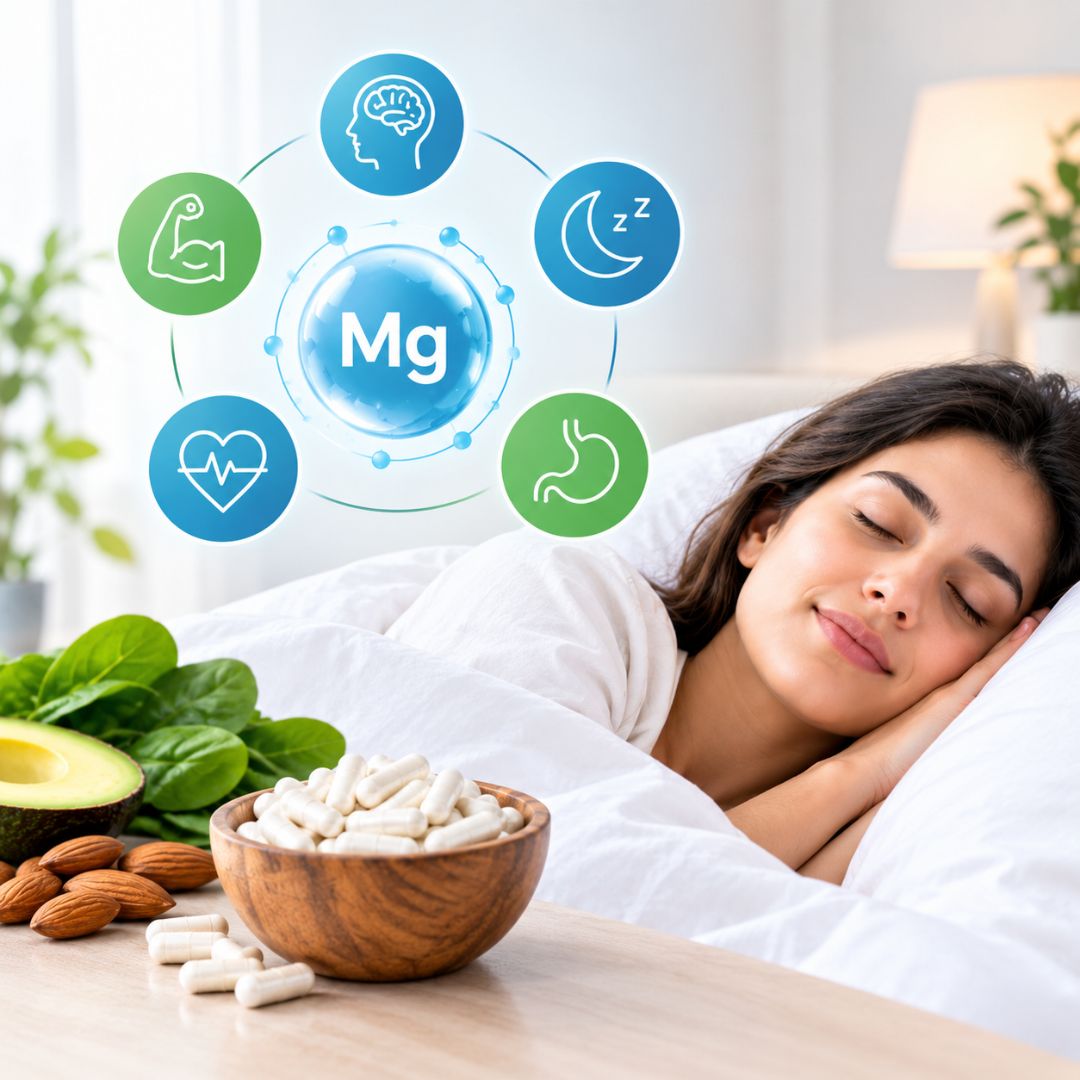
Magnesium Helps You Sleep. But That's Not Even Half the Story.
For some reason, magnesium has become the mineral of bedtime.
Open Instagram and you'll hear:
“Take magnesium before bed.”
“Magnesium for deep sleep.”
“Magnesium for relaxation.”
And yes, magnesium has been studied in relation to sleep.
But if that is the only thing you know about magnesium, you're missing a much bigger story.
Because your body doesn't only need magnesium at 10 PM.
It uses it all day.
Magnesium is involved in more than 300 enzymatic reactions and physiological processes throughout the body.
Which means calling it a “sleep supplement” is a little misleading.
Sleep may be one of the reasons people start paying attention to magnesium.
It is definitely not the only reason it matters.
Your Muscles Use Magnesium Every Day
Every time you move, your muscles are working through a complex series of signals and reactions.
Magnesium plays an important role in normal muscle and nerve function and is involved in the processes that allow muscles to contract and relax.
This is one reason magnesium belongs in conversations about exercise and physical activity.
Not because magnesium is a magic recovery powder.
But because adequate magnesium is part of normal physiological function.
Your muscles don't suddenly start needing magnesium when you go to the gym.
They're using it when you walk, stretch, climb stairs and move through your day too.
Magnesium Is Part of How Your Nervous System Communicates
Your nervous system is constantly sending messages.
Your brain communicates with your body. Your nerves communicate with your muscles. Your body is continuously receiving and responding to information.
Magnesium is involved in normal nerve function and signalling, making it one of the many nutrients working quietly in the background while your body does what it needs to do.
It's not glamorous.
You probably won't “feel” your magnesium working.
But not everything important in the body needs to be dramatic.
Magnesium Is Closely Connected to Energy
This part deserves more attention.
When we talk about energy, we usually think about coffee, carbohydrates or sleep.
But at the cellular level, magnesium is involved in energy metabolism and reactions involving ATP.
ATP is often called the body's energy currency.
And magnesium is deeply involved in how your cells produce and use it.
That doesn't mean magnesium gives you instant energy.
You won't take it at 3 PM and suddenly feel like you've had two coffees.
Its role is more fundamental than that.
Magnesium helps support the normal processes that allow your body to make and use energy in the first place.
It Is Also Involved in Protein Synthesis
Your body is constantly building, breaking down and repairing.
Magnesium is involved in protein synthesis and numerous cellular processes that keep this system running.
Again, not particularly Instagram-worthy.
But incredibly important.
The body is not a collection of separate systems working independently.
Muscles, nerves, energy metabolism and cellular function are constantly interacting.
And magnesium shows up across the entire picture.
So Yes, Let's Talk About Sleep Too
Sleep is still part of the story.
Magnesium has been studied for its relationship with relaxation and sleep, and maintaining adequate magnesium status is important for normal physiological function.
But it would be strange to reduce a mineral involved in hundreds of reactions throughout the body to one bedtime benefit.
That's like calling water a workout drink.
Technically, it can be.
But you're missing most of the point.
The Bigger Magnesium Conversation
Maybe magnesium doesn't need to be marketed as the next miracle sleep hack.
Maybe we should talk about it for what it actually is:
An essential mineral your body uses throughout the day.
Your muscles use it.
Your nervous system uses it.
Your cells use it.
Your energy metabolism depends on it.
And yes, your body uses it while you're asleep too.
Sleep may be where the conversation starts.
But magnesium has been busy long before bedtime.
Conclusion:
Magnesium has earned its place in the sleep conversation, but that's far from the whole story.
From supporting normal muscle and nerve function to playing a role in energy metabolism and protein synthesis, magnesium is involved in essential processes happening throughout your body, all day long.
You may think about magnesium at bedtime.
But your body doesn't.
Because magnesium doesn't clock in at night. It gets to work all day.
FAQs
1.Is magnesium just a sleep supplement?
Yes & No. Magnesium is an essential mineral involved in more than 300 enzymatic reactions and plays roles in normal muscle function, nerve function, energy metabolism and other cellular processes.
2. What does magnesium do in the body?
Magnesium contributes to several essential functions, including normal muscle and nerve function, energy metabolism, protein synthesis and normal cellular processes.
3. Why is magnesium important for energy?
Magnesium is involved in reactions related to ATP, the molecule often described as the body's cellular energy currency. It supports normal energy metabolism rather than acting as a stimulant.
4. Does magnesium help with muscle function?
Magnesium plays an important role in normal neuromuscular function and is involved in the processes associated with muscle contraction and relaxation.
5. Why is everyone suddenly talking about magnesium glycinate?
Magnesium glycinate has become popular because it is a form commonly chosen for regular supplementation and is known for its gastrointestinal tolerance.
6. What should I look for in a high-quality magnesium glycinate supplement?
Look at more than just the dose. The quality and source of the raw material, the form of magnesium and whether it is a properly characterised amino acid chelate can all be worth considering.
7. What is TRAACS® Magnesium?
TRAACS® is Balchem’s specialised system for amino acid chelated minerals, developed by Albion® Minerals. It helps ensure the magnesium is properly chelated with the amino acid glycine, creating a consistent, high-quality Magnesium Glycinate designed for better absorption and gentle digestion.
8. Where is it sourced from?
Our TRAACS® Magnesium Glycinate is sourced from Balchem, USA, through its globally recognised Albion® Minerals ingredient technology.


